🎨 Participatory Co-Design Workshops
🎨 Participatory Co-Design Workshops
Executive Summary
This document presents a complete visual description of the participatory co-design workshops conducted as part of the “Healthy is fresh” study in three rural subregions of Antioquia, Colombia.
📍 Study Context
Locations
Workshops were conducted in three rural municipalities of Antioquia:
- Medellín (peri-urban rural zone)
- Guarne (rural)
- Santa Rosa de Osos (rural)
Participants
- Total: 41 adults (18-70 years)
- Distribution: 21 women, 20 men
- Age groups: 18-30 years, 31-50 years, +50 years
- Profile: Members of rural cooperatives with diversity in education and occupation
🎯 Workshop Objectives
- Elicit local meanings of “healthy eating”
- Co-design ideal menus using visual food models
- Identify gaps between ideal and habitual diet
- Map barriers that limit healthy food choices
📋 Participatory Methodology
Co-Design Approach
Workshops used a participatory approach where participants are not passive subjects, but active co-creators of knowledge about healthy eating in their rural context.
graph LR
    A[Individual Reflection] --> B[Group Discussion]
    B --> C[Meal Co-Design]
    C --> D[Self-Assessment]
    D --> E[Barrier Mapping]
Tools Used
- 🍽️ Visual food models (adapted from Nelson et al., 1997)
- 📝 Individual reflection templates
- 📋 Collaborative recording charts
- 📸 Photographic documentation of co-designed meals
- 🎙️ Audio recordings (with consent)
📊 Workshop Structure (2 hours)
Phase 1: Welcome and Consent (10 min)
- Team and objectives presentation
- Confidentiality explanation
- Informed consent signature
- Brief sociodemographic questionnaire
Phase 2: Individual Reflection (15 min)
Materials Used
📄 Individual Reflection Template
Participants answered questions like:
- “What do you consider a healthy breakfast?”
- “What should a healthy lunch include?”
- “What should a healthy dinner contain?”
Purpose: Capture initial ideas without group influence, allowing personal concepts of “healthy” to emerge.
Phase 3: Share Group Reflections (10 min)
Each participant shared their ideas with the group, identifying:
- ✅ Consensus: Foods everyone considers healthy
- 🤔 Divergences: Foods with mixed opinions
- 💡 Surprises: Unexpected or innovative ideas
Phase 4: Ideal Menu Co-Design (40 min)
The Co-Design Process
Materials:
- Visual food models (food replicas)
- Food cards with photos
- Portion tokens
Activity: Groups built ideal meals for:
- Breakfast
- Mid-morning snack
- Lunch
- Afternoon snack
- Dinner
Visual Examples of Co-Designed Meals
🍳 Healthy Breakfast - Medellín, Group 2 (31-50 years)
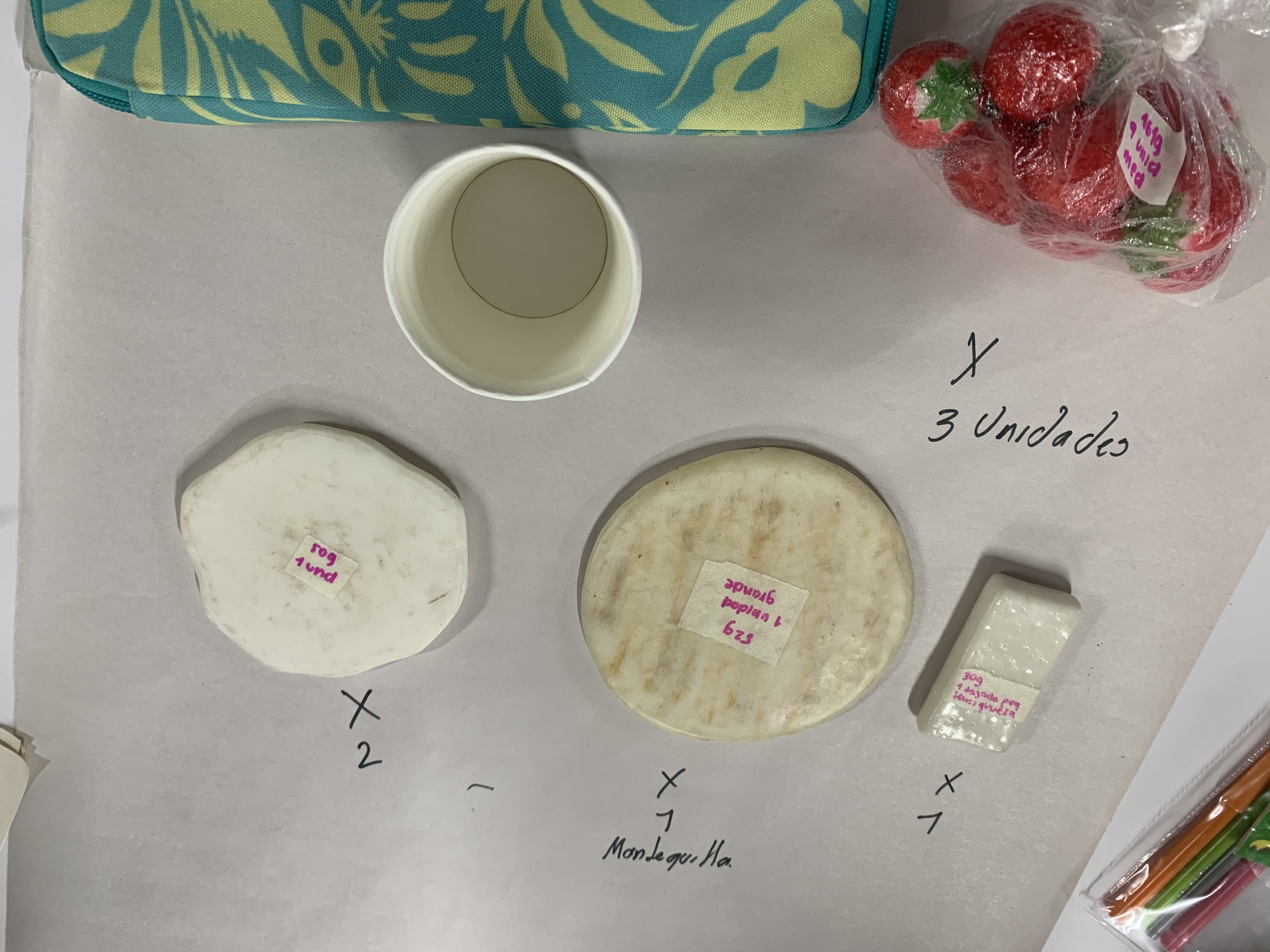
Selected components:
- Eggs (protein)
- Arepa (cereal)
- Fruits (plantain, papaya)
- Hot beverage (coffee with milk or light panela water)
Group reflection: “Breakfast should be complete and energetic, but without excess fat. Arepa is cultural, it cannot be eliminated.”
🍲 Healthy Lunch - Medellín, Group 2 (31-50 years)
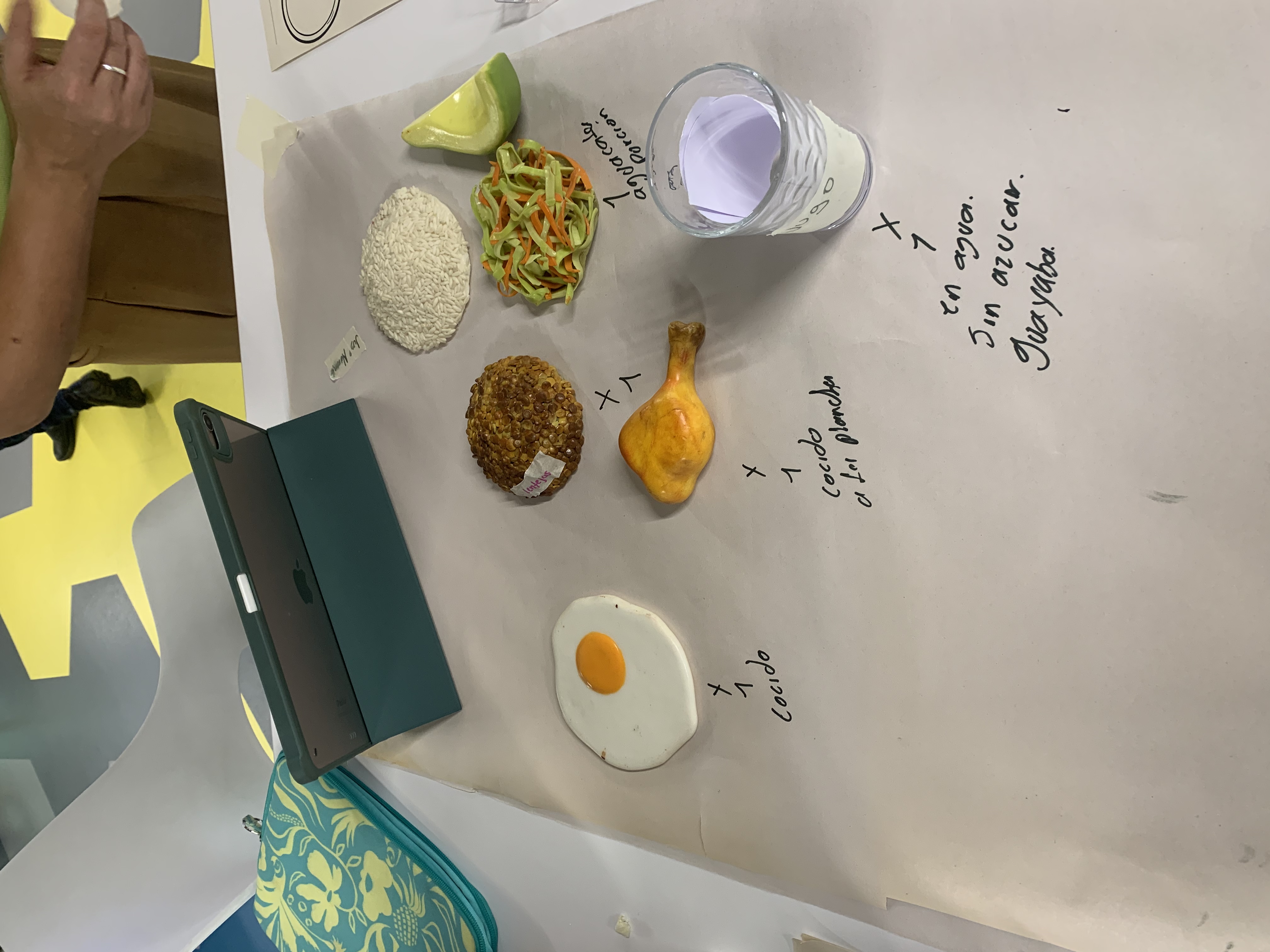
Selected components:
- Protein (chicken, fish or lean meat)
- Rice or potato (moderate portion)
- Salad (lettuce, tomato)
- Legumes (beans)
- Natural juice or water
Group reflection: “Lunch should include everything, but in small portions. Protein and beans are essential.”
🥗 Healthy Dinner - Medellín, Group 2 (31-50 years)
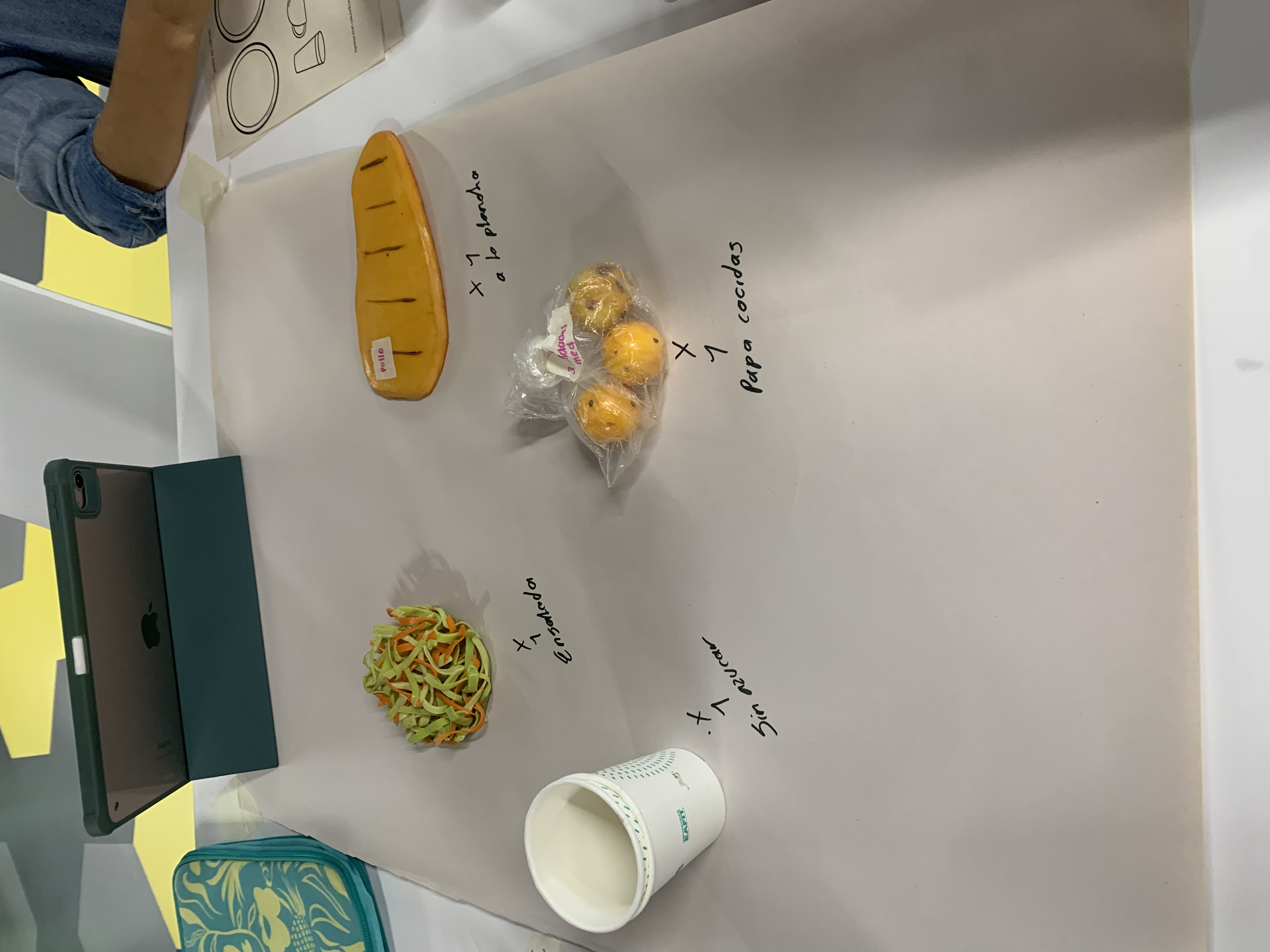
Selected components:
- Soup or broth
- Light protein (egg, cheese)
- Small arepa or whole wheat bread
- Infusion (herbal tea)
Group reflection: “Dinner should be light to not go to bed ‘full’. We prefer soups or something warm.”
🍎 Snacks - Medellín, Group 2 (31-50 years)
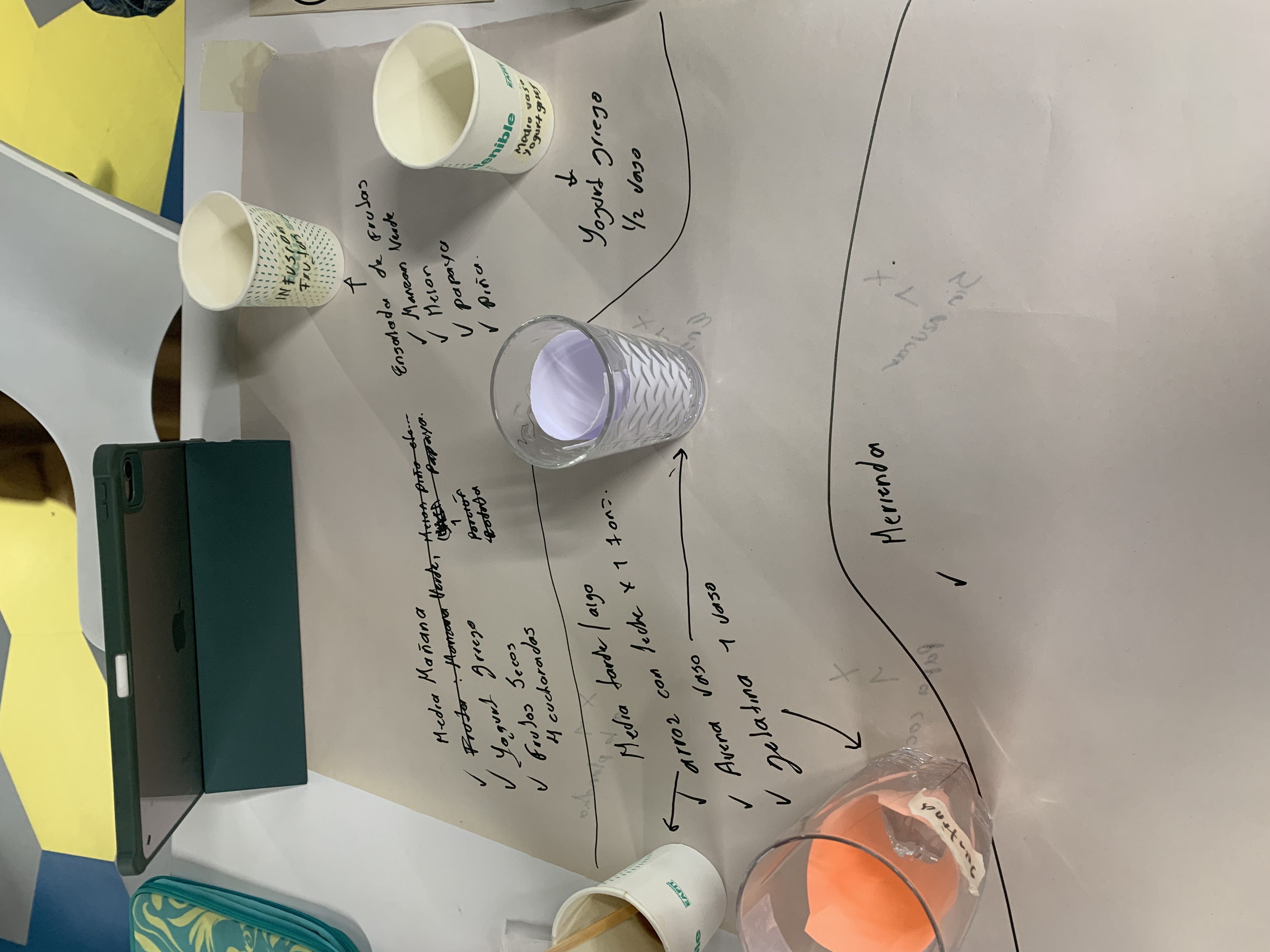
Selected components:
- Fresh fruits (banana, apple, papaya)
- Nuts (peanuts, almonds) - in small quantities
- Yogurt (low sugar)
Group reflection: “Snacks should satisfy hunger between meals without ‘filling’. Fruits are best, but sometimes there’s no time.”
🥘 Comparison Between Age Groups
Breakfast - Medellín, Group 3 (+50 years)
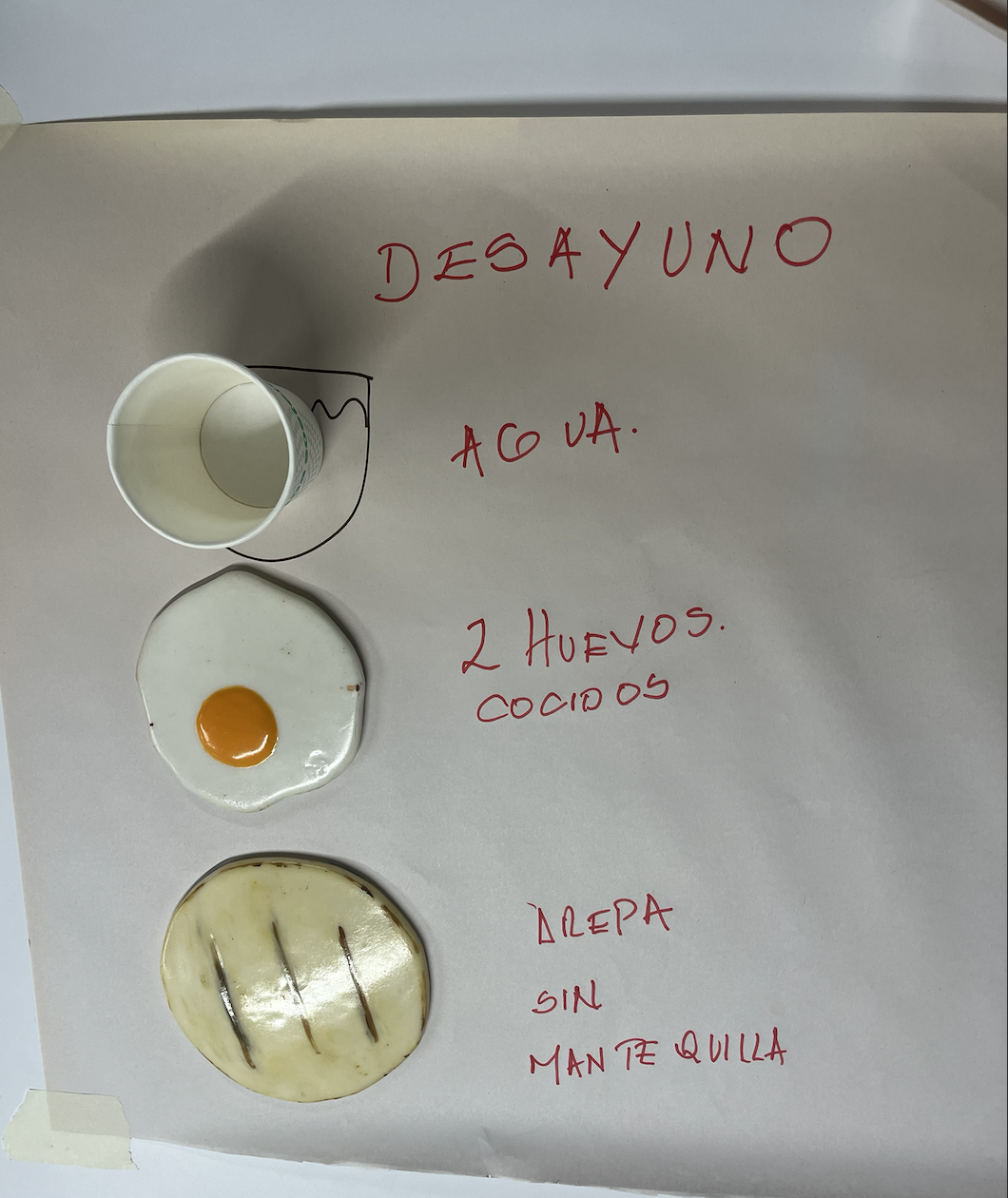
Observations:
- Greater emphasis on traditional preparations
- Less protein variety (egg as base)
- Preference for traditional hot beverages (panela water, coffee)
Lunch - Medellín, Group 3 (+50 years)
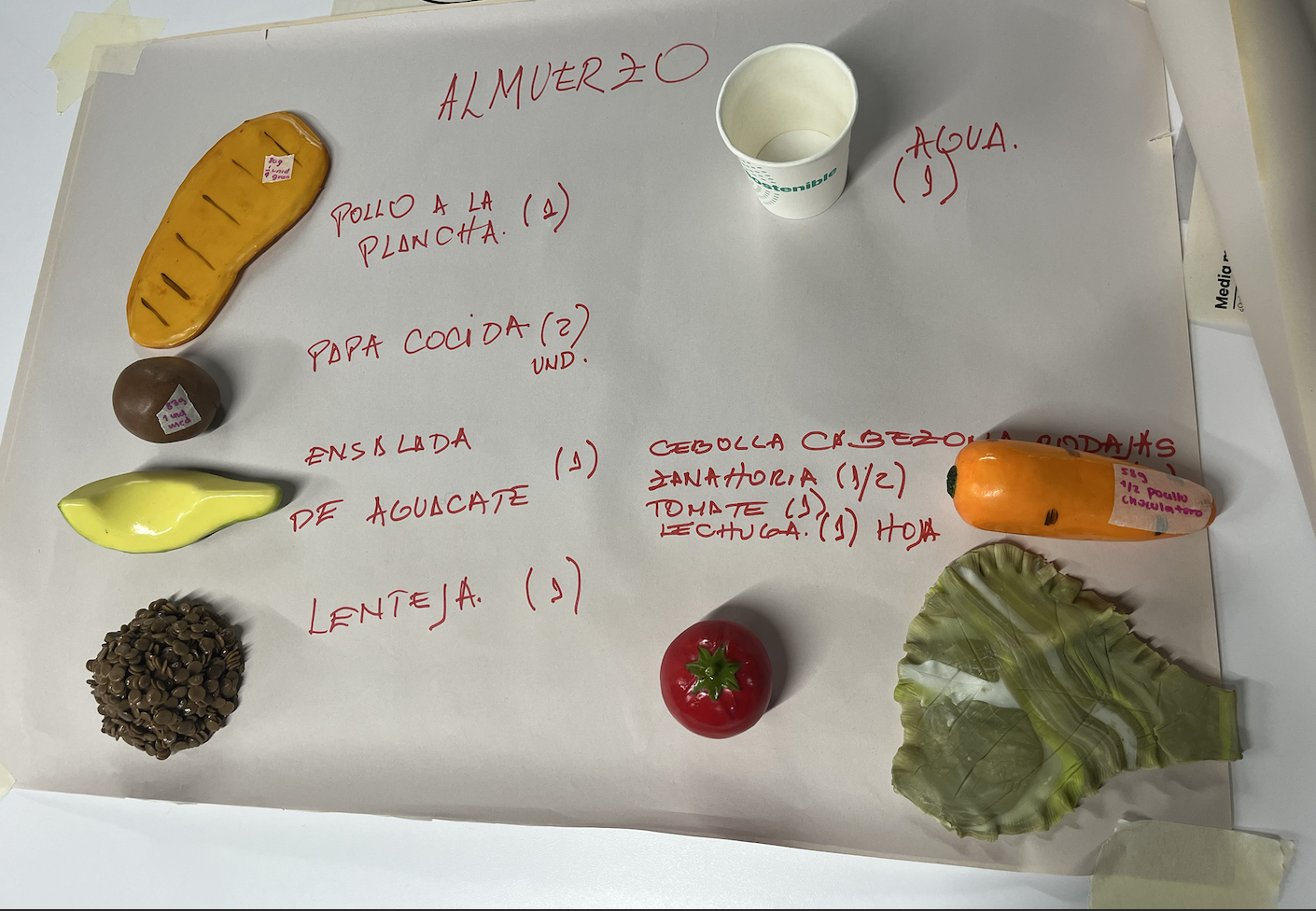
Observations:
- More “complete” plate in the traditional sense
- Larger carbohydrate portion (rice, potato, plantain)
- Consistent presence of protein and legumes
Dinner - Medellín, Group 3 (+50 years)
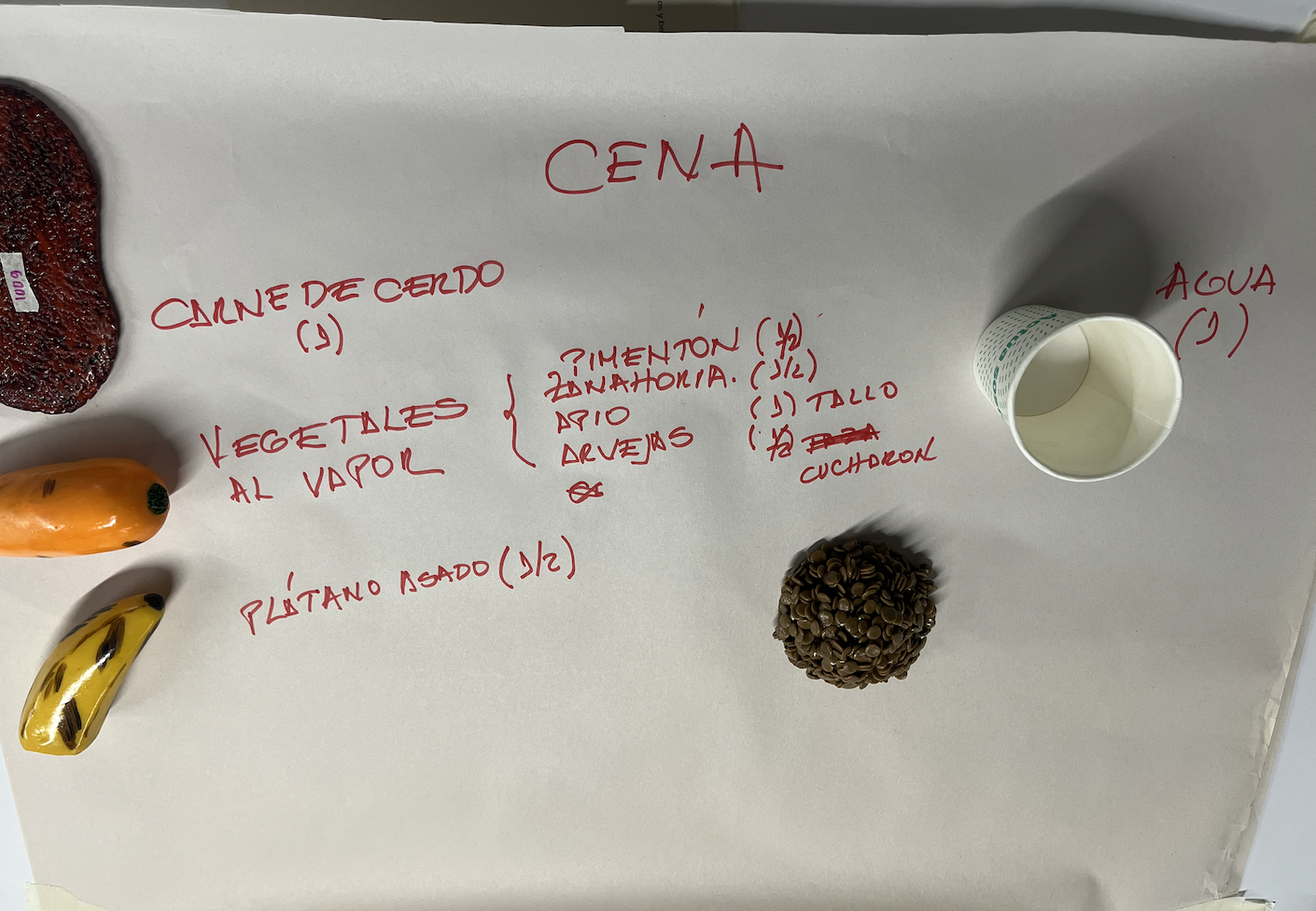
Observations:
- More substantial meal than younger groups
- Less distinction between lunch and dinner
- Preference for “hot food” vs. light options
Phase 5: Registration and Documentation (During Phase 4)
Registration Chart
📋 Meal Registration Format
For each co-designed meal, the following was recorded:
- ✅ Selected foods
- ✅ Approximate portions (using visual models)
- ✅ Corresponding GABAS food group
- ✅ Group observations and comments
Standardized Photographs
Each meal was photographed following a protocol:
- 📸 Overhead view (from above)
- 📸 Good lighting
- 📸 Visible label with region, age group, and meal time
- 📸 No participant faces (to protect privacy)
Phase 6: Alignment Assessment (15 min)
Alignment Scale (1-5)
Participants rated how close their habitual diet is to the ideal menu they co-designed:
1.0 = Very far (almost never eat like this)
2.0 = Quite far
3.0 = Moderately close (sometimes)
4.0 = Quite close (frequently)
5.0 = Totally aligned (eat like this every day)
Aggregated Results
Rating distribution:
- Minimum: 1.5
- Average: 2.5-3.5
- Maximum: 4.5
Interpretation: Significant gap between co-designed ideal and actual practice.
“I know how I should eat, but I can’t always do it.” - Participant, Guarne
Phase 7: Barrier Discussion (25 min)
Central Question
“What prevents you from reaching 5.0? What makes it difficult to eat like the ideal we designed?”
Identified Barrier Categories
💰 1. Economic
- “Eating healthy is very expensive”
- “Whole grain or sugar-free products cost double”
- “One has to prioritize: food or medicine”
🛒 2. Access and Availability
- “In town there’s no variety of vegetables”
- “When fresh vegetables arrive they’re already spoiled”
- “You have to go to the city to get variety”
⏰ 3. Time
- “I come home tired from work and the easiest thing is to fry something”
- “Cooking healthy requires more time”
- “Weekends are when you most ‘deviate from the plan’”
🍟 4. Preferences and Habits
- “Everything tastes better fried”
- “My kids don’t eat salad”
- “We’ve been eating like this for years”
😰 5. Emotional
- “When I’m stressed I eat more sweets”
- “Anxiety makes me snack between meals”
- “On Sundays I reward myself with ‘forbidden’ food”
🤷 6. Knowledge/Uncertainty
- “I don’t really know what the correct portions are”
- “I don’t understand nutrition labels well”
- “I don’t know how to cook some vegetables”
Phase 8: Closure and Reflection (5 min)
- Thank participants
- Summary of key group learnings
- Explanation of next steps (analysis and dissemination)
- Contact for questions or follow-up
📊 Workshop Products
1. Qualitative Data
✅ Complete transcriptions of discussions (restricted for ethical reasons)
✅ Field notes from facilitators
✅ Thematic codes of barriers and meanings
2. Quantitative Data
✅ Food portions selected in ideal menus
✅ Classification by GABAS groups (Dietary Guidelines)
✅ Estimated nutritional composition (RIEN)
✅ Alignment scales (1-5)
3. Visual Evidence
✅ 200+ photographs of co-designed meals
✅ Organized by region and age group
✅ Visual documentation of the process
See: Pictures/
🔍 Key Workshop Findings
Meanings of “Healthy”
Participants defined “healthy” primarily as:
- “Fresh” - Unprocessed, freshly prepared
- “Home-made” - Prepared at home, not store-bought
- “Natural” - Without chemicals or preservatives
- “Balanced” - “A bit of everything” (diffuse concept)
- “Prevent diseases” - Association with long-term health
Important note: They rarely mentioned specific nutrients (proteins, vitamins, etc.). Meanings are cultural and experiential, not technical-scientific.
Patterns in Ideal Menus
✅ Consistently Included Foods:
- Eggs - In almost all breakfasts
- Legumes - Beans especially
- Rice - Although portion is debated
- Plantain - Both as side dish and fruit
- Chicken/Meat - Preferred animal protein
⚠️ Under-Represented Foods:
- Vegetables - Limited to simple salad (lettuce, tomato)
- Dairy - Especially in older groups
- Fish - Little presence (limited access)
- Fruit variety - Repeat banana, papaya, orange
❌ Foods Excluded from “Ideal”:
- Soft drinks
- Ultra-processed snacks (chips, sweet cookies)
- Processed meats
- Fast food (hamburgers, pizza)
Paradox: Although excluded from the ideal, in the barrier discussion participants admit to consuming them frequently in practice.
The Ideal-Practice Gap
Average alignment: 2.8 / 5.0
Factors that Widen the Gap:
graph TD
    A[Co-Designed Ideal] -->|Economic Barrier| B[Actual Practice]
    A -->|Access Barrier| B
    A -->|Lack of Time| B
    A -->|Entrenched Habits| B
    A -->|Emotional Factors| B
    A -->|Context Outside Home| B
Specific Contexts:
- Better alignment: At home, weekends, with planning
- Worse alignment: Away from home, during work, weekends (paradox), under stress
🎓 Methodological Lessons Learned
What Worked Well ✅
- Visual models: Facilitated communication about portions
- Group co-design: Generated rich discussions and negotiations
- Separate age groups: Allowed generational differences to emerge
- Photographs: Objective documentation complementary to transcriptions
- Trained facilitators: Essential to maintain neutrality
Challenges Faced ⚠️
- Social desirability: Some participants wanted to “answer correctly”
- Limited time: 2 hours were just enough, some groups wanted more time
- Literacy: Variability in writing ability (individual phase)
- Interruptions: Logistics in rural communities (calls, noise)
- Expectations: Some expected “recipes” or direct nutritional advice
Recommendations for Replication 💡
- ✅ Pilot materials locally
- ✅ Adapt foods to regional contexts
- ✅ Train facilitators in participatory techniques
- ✅ Prepare logistical contingencies
- ✅ Manage expectations from the start
- ✅ Include snacks (appropriate to the theme)
- ✅ Respect local time (not “urban time”)
📥 Downloadable Materials
Workshop Forms
| Material | Description | Link |
|---|---|---|
| Reflection Templates | Breakfast, lunch, dinner, barriers | |
| Registration Chart | To document co-designed meals | |
| Extra Materials | Scales, discussion questions |
Methodological Guides
| Material | Description | Folder |
|---|---|---|
| Workshop Design | Methodological notes and protocol | View folder |
| Visual Evidence | 200+ photos of co-designed meals | View folder |
📸 Evidence Gallery
By Region
1. Medellín (Peri-urban Rural)
2. Guarne (Rural)
3. Santa Rosa de Osos (Rural)
🔬 From Workshop to Analysis
Data Flow
graph LR
    A[Workshop] --> B[Photographs]
    A --> C[Transcriptions]
    A --> D[Registration Charts]

    B --> E[Food Identification]
    D --> E
    E --> F[Portion Estimation]
    F --> G[GABAS Classification]
    F --> H[RIEN Nutritional Composition]

    C --> I[Thematic Coding]
    I --> J[Barriers and Meanings]

    G --> K[Quantitative Analysis]
    H --> K
    J --> L[Qualitative Analysis]

    K --> M[Benchmarking with Guidelines]
    L --> M
    M --> N[Integrated Joint Display]
Analyses Performed
Quantitative:
- ✅ Comparison with GABAS (food groups)
- ✅ Comparison with RIEN (nutritional adequacy)
- ✅ Heatmaps by age group
- ✅ Divergence graphs
View results: Analysis_Quantitative/graphs/
Qualitative:
- ✅ Thematic analysis of meanings
- ✅ Coding of barriers (6 categories)
- ✅ Analysis of ideal-practice gap
- ✅ Patterns by age group
View results: Analysis_Qualitative/
Mixed Integration:
- ✅ Joint display aligning themes with benchmarking
- ✅ Interpretation of nutritional divergences through barriers
- ✅ Identification of intervention targets
See integration in: Main article (Table 1, Joint Display)
🌍 Implications for Interventions
Key Insights for Policy Design
1. Beyond nutrition education
Participants have clear ideas of “healthy,” but structural barriers (cost, access, time) are more determinant than knowledge.
Recommendation: Interventions should address access and affordability, not just “information.”
2. Respect local heuristics
“Fresh” and “home-made” are culturally powerful anchors. Interventions can leverage them.
Recommendation: Frame messages around “fresh” and “home-made,” not just technical nutrients.
3. Context matters
Alignment is situation-dependent (better at home, worse outside).
Recommendation: Context-specific interventions for work settings, community cafeterias, etc.
4. Underestimated emotional factors
“Emotional eating” is an important but underrecognized barrier.
Recommendation: Interventions should include stress/anxiety management components.
5. Age diversity
Different groups prioritize different values (tradition vs. restriction/control).
Recommendation: Age-segmented messages, not “one size fits all.”
📚 Publications and Dissemination
Main Article
Arcila-Agudelo, A.M., Cardona-Trujillo, H., Herazo-Castelblanco, A.S., Mejía-Gil, M.C., Muñoz-Mora, J.C., & Ortiz-Pradilla, T. (2026). “Healthy is fresh”: A participatory study of meal ideals and barriers shaping food choice in rural Colombia. [Journal Name].
Supplementary Materials (This Repository)
🌐 Website: https://jcmunozmora.github.io/food-perception-rural-colombia
📦 GitHub Repository: https://github.com/jcmunozmora/food-perception-rural-colombia
📋 Includes:
- Reusable forms
- Reproducible analysis scripts
- Anonymized data
- Visual evidence
- Methodological guides
📧 Contact and Inquiries
About the Workshop and Participatory Methodology:
María Claudia Mejía-Gil
📧 mmejiagi@eafit.edu.co
Workshop coordination and design
Tatiana Ortiz-Pradilla
📧 tortizpr@eafit.edu.co
Facilitation and qualitative analysis
About Data and Evidence:
Ana María Arcila-Agudelo (Corresponding Author)
📧 ana.arcila@uniremington.edu.co
Overall study coordination
Ana Sofia Herazo-Castelblanco
📧 asherazoc@eafit.edu.co
Transcriptions and fieldwork
To Replicate the Workshop in Another Context:
All materials are available under CC BY 4.0 license. You can:
- ✅ Download and adapt forms
- ✅ Use the methodology (with appropriate citation)
- ✅ Request advice for adaptation
Contact for advice: mmejiagi@eafit.edu.co / ana.arcila@uniremington.edu.co
⚖️ Ethical Aspects
Ethical Approval
- Committee: Research Ethics Committee, Universidad EAFIT
- Protocol: Comité de Ética-2022-07
- Approval: September 5, 2022
Participant Protection
✅ Informed consent from all participants
✅ Photographs without identifiable faces
✅ Anonymized transcriptions (names and places removed)
✅ Aggregated data to protect identity in small communities
✅ Restricted audio recordings (not public)
Access to Sensitive Data
Complete transcriptions available upon request and ethical approval for:
- Researchers with approved protocols
- Legitimate academic purposes
- With confidentiality guarantees
Requests: ana.arcila@uniremington.edu.co
🙏 Acknowledgments
This work would not have been possible without:
- The 41 participants who generously shared their time, experiences, and knowledge
- Community leaders and cooperative coordinators in Medellín, Guarne, and Santa Rosa de Osos
- Facilitators and assistants who conducted workshops with sensitivity and professionalism
- FAO Colombia for technical and methodological support
- Universidad EAFIT and Corporación Universitaria Remington for institutional support
📖 How to Cite
The Workshop:
@misc{arcila-agudelo2026workshop,
  author = {Arcila-Agudelo, Ana María and Mejía-Gil, María Claudia and
            Ortiz-Pradilla, Tatiana and Herazo-Castelblanco, Ana Sofia},
  title = {Participatory Co-Design Workshops: Methodology and Materials},
  year = {2026},
  howpublished = {GitHub repository},
  url = {https://github.com/jcmunozmora/food-perception-rural-colombia/blob/main/WORKSHOP.md}
}
The Complete Study:
@article{arcila-agudelo2026healthy,
  title={"Healthy is fresh": A participatory study of meal ideals and
         barriers shaping food choice in rural Colombia},
  author={Arcila-Agudelo, Ana María and Cardona-Trujillo, Harold and
          Herazo-Castelblanco, Ana Sofia and Mejía-Gil, María Claudia and
          Muñoz-Mora, Juan Carlos and Ortiz-Pradilla, Tatiana},
  journal={[Journal Name]},
  year={2026}
}
🔗 Useful Links
- 🏠 Repository main page
- 🚀 Quick start guide
- 📊 Quantitative analysis
- 📝 Qualitative analysis
- 👥 Author information
- ⚖️ CC BY 4.0 License
- 📋 Downloadable forms
- 📸 Photo gallery
Last updated: February 14, 2026
This document is part of the supplementary materials of the “Healthy is fresh” study and is available under Creative Commons Attribution 4.0 International License (CC BY 4.0).